Covering Laws and Terms
There are many laws
that apply to my project, mostly having to do with how magnetic fields interact
with my system. These laws include Faraday's and Lenz's Law, which are commonly
grouped together as they were based on one another, Earnshaw's Theorem about
magnetic levitation, the concepts surrounding Eddy Currents, and other
electrical terms such as resistivity and magnetic permeability.
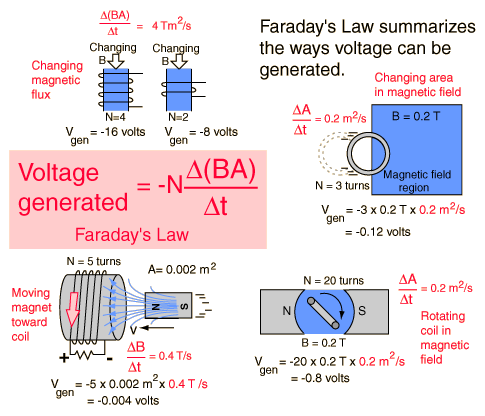 Faraday's Law and
Lenz's Law are very important to my project because they explain how moving
electricity through a coil of magnet wire will create a magnetic field. This is
important because these two laws explain how my non-contact motor-generator can
utilize the magnets on my axis to get my FES spinning. Faraday’s Law explains
how the movement of coils along a magnetic field produces a current in the
wire. The three ways are to move a magnet through a coil, to move the coil in
the x- and y- directions in relation to the magnetic field, or to rotate the
coil perpendicular to the magnetic field. The coil will not generate
electricity if it is not moving along rings of the magnetic field (if it is in
line with the magnetic field). <See the picture on the right from
hyperphysics.phys-astr.gsu.edu>. In simpler terms, a current is produced if
a magnet is passed over multiple lines of the magnetic field produced by the
coil.
Faraday's Law and
Lenz's Law are very important to my project because they explain how moving
electricity through a coil of magnet wire will create a magnetic field. This is
important because these two laws explain how my non-contact motor-generator can
utilize the magnets on my axis to get my FES spinning. Faraday’s Law explains
how the movement of coils along a magnetic field produces a current in the
wire. The three ways are to move a magnet through a coil, to move the coil in
the x- and y- directions in relation to the magnetic field, or to rotate the
coil perpendicular to the magnetic field. The coil will not generate
electricity if it is not moving along rings of the magnetic field (if it is in
line with the magnetic field). <See the picture on the right from
hyperphysics.phys-astr.gsu.edu>. In simpler terms, a current is produced if
a magnet is passed over multiple lines of the magnetic field produced by the
coil.
Lenz's Law builds
off of the concept of Faraday's Law. Lenz's Law states that if a magnetic field
causes a current to flow through a coil, then the coil will generate its own
magnetic field. This magnetic field resists the original magnetic field in an effort
of resisting change, causing a lower energy output than input. However, if the
magnetic field that acts on the coil is decreasing, then the magnetic field of
the coil will add onto the original magnetic field in an attempt to keep
equilibrium. This concept is seen in the efficiency of the motor-generator of
my project, which will vary depending on the core implemented in each coil of
magnet wire.
Earnshaw's Theorem
is quite different from Faraday's and Lenz's Law, as it deals with the whole
design of my FES rather than how the system works. Earnshaw's Theorem is quite
simple, as it states that any object can never reach equilibrium by only utilizing
magnetic levitation. After hearing about this theorem, I added an important
feature to my design: the small point on the end of my shaft that pushes into
the glass. Although this point results in a point of contact, which causes a
frictional force to slow down the FES and lose efficiency, this point is very
important at keeping the FES balanced and levitating.
Going back to
electrical properties, probably the most confusing electrical property in my
project are Eddy Currents. Eddy currents are reverse currents created on the
surface of metal conductors by a changing magnetic field. The intensity of the
current is based on the strength of the magnetic field and is inversely related
to the resistivity of the material of the core. Eddy currents are problematic
since they cause a loss of energy in the form of heat. This concept is
important because Eddy currents will be present in all of my cores except the
air core, which will be interesting to see how the absence of Eddy currents
will affect the air core, even though the air core produces much weaker
magnetic fields due to the lack of a metal core to stimulate the magnetic
fields.
Resistivity and
magnetic permeability relate back to the electrical laws already discussed in
this post. Resistivity is a measure of the resisting power of a specified
material to the flow of an electric current. In my project, each of the
different cores are made of unique materials with different levels of
resistivity, which will change the efficiency of the coil. The other major term
is magnetic permeability, which is how a specific material changes the
intensity of a magnetic field. Similar to resistivity, the different cores will
have different levels of permeability, which will increase or decrease the
strengths of the magnetic fields, which will change the amount of time it takes
that coil to get the FES spinning.

Comments
Post a Comment